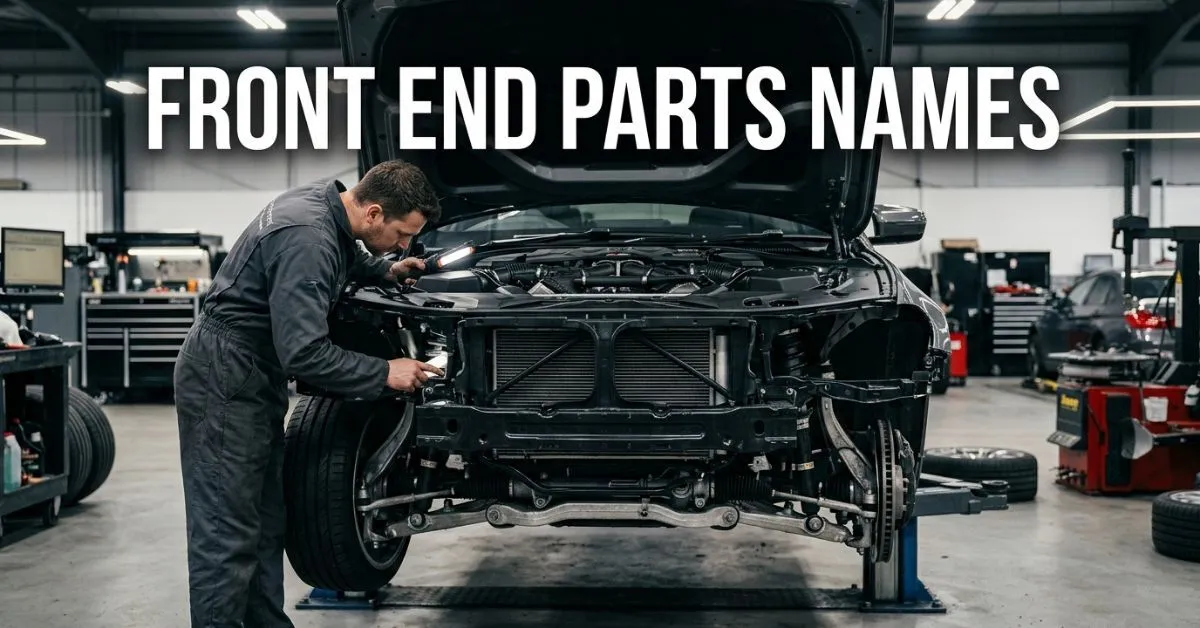
When someone says front end parts names, it can sound like a simple question. But the front of a car is packed with parts that work together every time you drive.
Some are easy to see, like the hood, bumper, grille, and headlights. Others sit behind the panels or under the car, such as control arms, ball joints, tie rods, struts, and steering knuckles.
Knowing these names can make car repairs much less confusing. It can also help when a mechanic gives you a repair estimate, when you are looking for a replacement part, or when you simply want to understand your vehicle better.
In this guide, we will break down the most common front end parts names in plain American English. You will find exterior body parts, suspension components, steering parts, cooling components, lights, structural pieces, and more.
I’ll also explain what each part does in simple terms, so you can connect the name with the actual part.
⚡ Quick Answer
The main front end parts names: of a car include the hood, front bumper, grille, fenders, headlights, radiator, radiator support, control arms, ball joints, struts, tie rods, steering knuckles, sway bar, wheel hubs, and related components. The exact parts vary by vehicle design, but these are common front-end components.
🚗 What Do Front End Parts Names Really Mean?
“Front end parts names” simply means the names of the components located at or around the front section of a vehicle. That includes visible body panels, hidden structural parts, steering components, suspension parts, cooling equipment, and lighting.
The front end is not one single system. It is a group of systems working together. The suspension helps keep the tires connected to the road, while steering components turn the wheels. Body parts protect the vehicle and shape its appearance, while cooling parts help manage engine heat.
In my years studying naming patterns in automotive content, I’ve found that people usually understand these parts much faster when they are grouped by where they are and what they do, rather than shown as one giant list.
🛞 Common Front End Body Parts

The body is the easiest place to start because these parts are usually visible from outside the vehicle. They create the car’s shape while helping protect important components underneath. Here are some of the front body parts you are most likely to see.
- Hood
Meaning: The large hinged panel that covers the engine compartment and opens for access to the engine. - Front Bumper
Meaning: The protective structure at the front of the vehicle that helps manage impact forces during collisions. - Front Bumper Cover
Meaning: The outer plastic or composite covering that gives the bumper its finished appearance. - Front Fender
Meaning: The body panel surrounding the upper area of a front wheel and helping protect the vehicle from road debris. - Front Grille
Meaning: The opening or decorative panel at the front that allows airflow toward cooling components. - Front Fascia
Meaning: The complete front-facing exterior area that can include the bumper cover, grille, lights, and surrounding trim. - Front Valance
Meaning: A lower front body panel that sits near the bumper and may help guide airflow. - Hood Latch
Meaning: The mechanism that locks the hood securely in place while the vehicle is moving. - Cowl Panel
Meaning: The area between the hood and windshield that helps manage water and houses parts of the wiper system. - Splash Shield
Meaning: A protective panel that helps block water, dirt, and road debris from reaching components behind the front wheel.
🏆 Best Choice: Front Fascia is the most useful term when you want to describe the whole visible face of a modern car rather than one individual body panel.
💡 Front Lighting Parts
Front lights do more than make a vehicle look sharp. They help the driver see, help other road users see the vehicle, and support visibility in different driving conditions. Lighting designs vary widely between vehicles, especially between older halogen systems and newer LED systems.
- Headlight
Meaning: A front lamp that illuminates the road ahead when driving in low-light conditions. - Headlight Housing
Meaning: The outer assembly that holds and protects the headlight’s internal components. - Headlight Lens
Meaning: The clear outer cover that protects the lighting components from the environment. - High-Beam Lamp
Meaning: The lighting function designed to provide a longer and brighter view ahead when conditions allow. - Low-Beam Lamp
Meaning: The main forward-facing light used for normal nighttime driving without strongly dazzling other drivers. - Daytime Running Light
Meaning: A front light designed to make a moving vehicle easier for others to notice during daylight. - Fog Light
Meaning: A low-mounted front lamp designed to improve visibility in certain foggy or poor-weather conditions. - Front Turn Signal
Meaning: A light that tells other road users the driver intends to turn or change direction. - Side Marker Light
Meaning: A small light near the front side of some vehicles that helps make the vehicle more visible. - Headlight Washer Nozzle
Meaning: A small nozzle on some vehicles that sprays cleaning fluid onto the headlight lens.
🏆 Best Choice: Headlight is the key term to know first because it is one of the most recognizable front-end components and is central to nighttime visibility.
🧊 Front Cooling System Parts
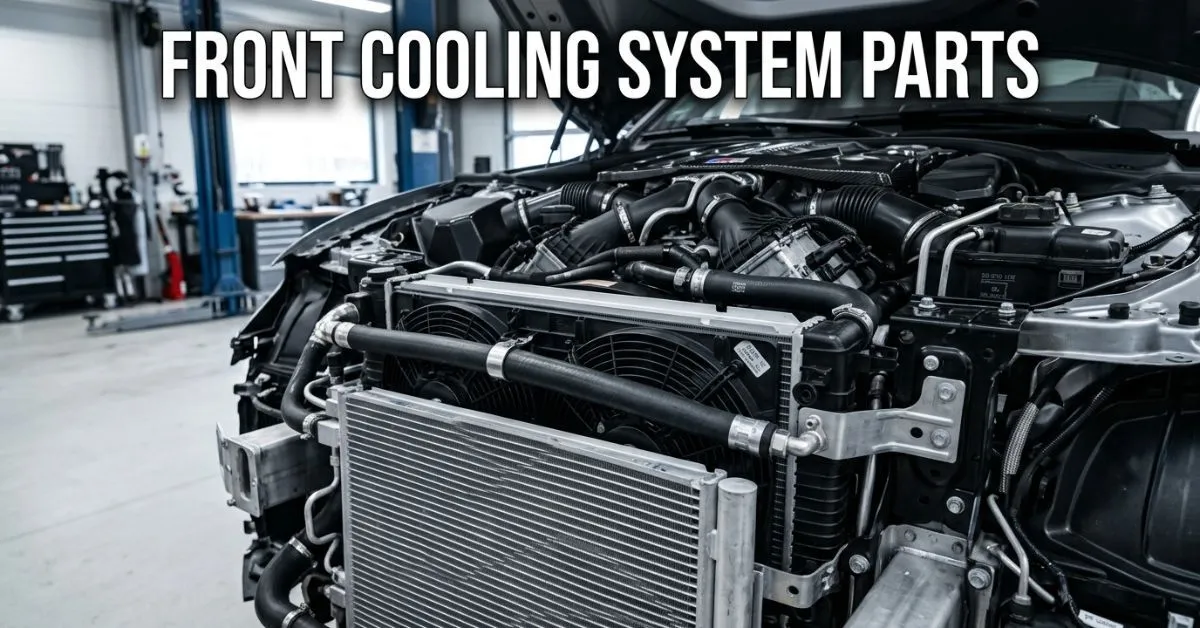
Under the hood, several front-end components help control engine temperature. Air enters through the front of the vehicle and passes through cooling equipment while the car moves. The radiator is one of the most important pieces in this area because it transfers heat from engine coolant to surrounding air.
- Radiator
Meaning: A heat exchanger that releases heat from engine coolant into the surrounding air. - Radiator Fan
Meaning: A fan that moves air through the radiator when additional airflow is needed. - Radiator Support
Meaning: The structural framework that supports the radiator and may also hold other front-end components. - Radiator Shroud
Meaning: A surrounding panel that helps direct airflow through the radiator fan and cooling area. - Coolant Reservoir
Meaning: A tank that stores coolant as it expands and contracts during temperature changes. - Radiator Cap
Meaning: A pressure-control cap that seals the cooling system and helps maintain the proper system pressure. - Upper Radiator Hose
Meaning: A flexible hose that carries coolant between the engine and upper area of the radiator. - Lower Radiator Hose
Meaning: A hose that carries coolant between the lower radiator area and the engine cooling circuit. - Intercooler
Meaning: A heat exchanger that cools compressed intake air on many turbocharged or supercharged engines. - Air Deflector
Meaning: A panel that guides airflow toward or around cooling components.
🏆 Best Choice: Radiator is the most important starting point in this section because it is the main component most people associate with front-end engine cooling.
🔧 Front Suspension Parts
The front suspension connects the vehicle to its front wheels while helping manage bumps, movement, stability, and tire contact with the road. Its exact design depends on the vehicle. For example, a common MacPherson strut setup can include strut assemblies, control arms, ball joints, steering knuckles, sway bars, and end links.
- Control Arm
Meaning: A suspension link that connects the wheel assembly to the vehicle structure while allowing controlled wheel movement. - Ball Joint
Meaning: A pivoting joint that connects suspension components and allows the steering knuckle to move in different directions. - Strut
Meaning: A suspension assembly that combines structural support with damping in many vehicle designs. - Shock Absorber
Meaning: A damping component that controls suspension movement and reduces excessive bouncing. - Coil Spring
Meaning: A metal spring that supports vehicle weight and absorbs energy from bumps. - Sway Bar
Meaning: A stabilizer bar that connects parts of the suspension and helps reduce body roll during turns. - Sway Bar End Link
Meaning: A connecting link that attaches the sway bar to the suspension. - Strut Mount
Meaning: A mounting component that connects the top of a strut assembly to the vehicle body. - Strut Bearing
Meaning: A bearing that allows the upper strut assembly to rotate as the front wheels are steered. - Bump Stop
Meaning: A cushioning component that limits excessive suspension travel when the suspension reaches its maximum movement.
🏆 Best Choice: Control Arm stands out here because it is a major connection between the vehicle structure and wheel assembly and plays an important role in controlled suspension movement.
📸 Front Steering Parts
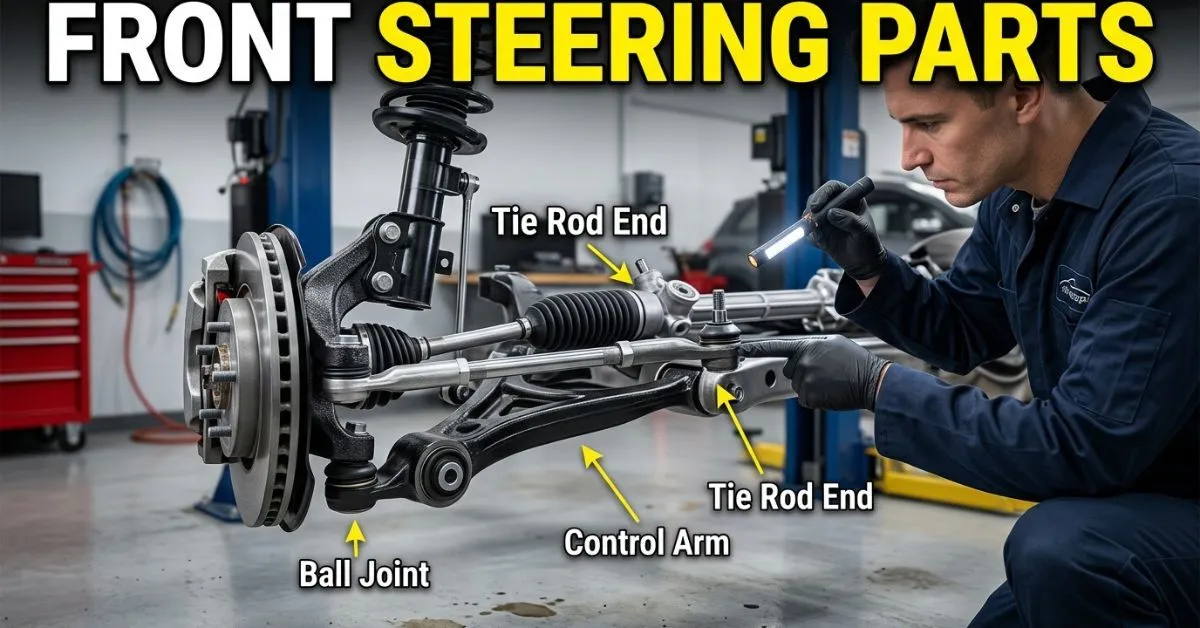
Steering components turn the driver’s input into movement at the front wheels. The exact setup varies, but many modern vehicles use rack and pinion steering with inner and outer tie rods. A steering linkage provides the mechanical connection between the steering gear and the front wheels.
- Steering Rack
Meaning: The steering mechanism that changes steering input into side-to-side movement for the front wheels. - Pinion Gear
Meaning: A small gear inside a rack-and-pinion system that moves the steering rack when the steering wheel turns. - Inner Tie Rod
Meaning: A steering linkage component connecting the steering rack to the outer tie rod. - Outer Tie Rod End
Meaning: A joint that connects the steering linkage to the steering knuckle and transfers steering movement. - Steering Knuckle
Meaning: A major front-wheel mounting component that connects steering, suspension, and wheel-hub components. - Steering Linkage
Meaning: The group of mechanical parts that transfers steering movement toward the front wheels. - Pitman Arm
Meaning: A steering linkage arm used on certain steering-box systems to transfer movement into the linkage. - Idler Arm
Meaning: A support component used in some steering systems to help hold the linkage in its correct position. - Center Link
Meaning: A steering linkage piece used in some traditional steering layouts to connect several steering components. - Drag Link
Meaning: A steering linkage component used in certain vehicle designs to transfer movement from the steering gear toward the steering wheels.
🏆 Best Choice: Steering Knuckle is the standout term for understanding how several front-end systems meet because it connects steering, suspension, and wheel-related components in one area.
🏗️ Front Structural Parts
Some front-end parts are easy to see, while others are hidden behind the bumper, grille, or body panels. Structural parts help support major components and keep the front section properly assembled. Their design varies by vehicle, so not every car uses every part listed below.
- Front Crossmember
Meaning: A strong structural member that supports or connects important front-end components. - Front Subframe
Meaning: A separate structural frame that can carry suspension, steering, and other front-end components. - Upper Tie Bar
Meaning: A structural support near the upper front section that can connect the sides of the engine bay. - Lower Tie Bar
Meaning: A lower structural support that helps connect and stabilize front-end components. - Bumper Reinforcement
Meaning: A strong internal beam that sits behind the bumper cover and helps manage impact forces. - Bumper Absorber
Meaning: A cushioning component positioned behind some bumper covers to help absorb energy during certain impacts. - Core Support
Meaning: Another common name for the structure that supports the radiator and nearby front-end components. - Hood Hinge
Meaning: A hinged connection that allows the hood to open and close. - Hood Support Rod
Meaning: A rod used on some vehicles to hold the open hood in position. - Hood Gas Strut
Meaning: A pressurized support that helps lift and hold the hood open on many modern vehicles.
🏆 Best Choice: Front Subframe is the most useful name to remember when discussing the major structural assembly that supports several suspension and steering components.
⚙️ Front Wheel and Hub Parts
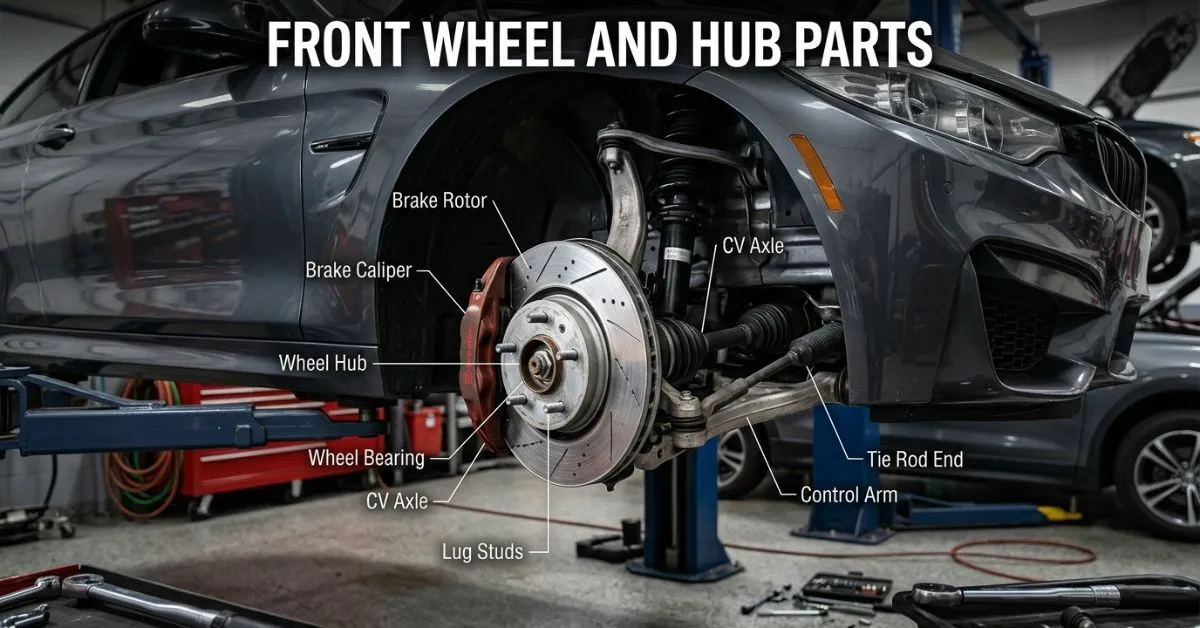
The wheel area brings several systems together. The hub, bearing, knuckle, brake assembly, and axle all work around the front wheel, although the exact setup changes with the vehicle’s drivetrain and suspension design.
- Wheel Hub
Meaning: The central mounting component where the wheel attaches to the vehicle. - Wheel Bearing
Meaning: A bearing that allows the wheel and hub assembly to rotate smoothly. - Hub Assembly
Meaning: A combined unit that may contain the hub, bearing, and other wheel-speed components. - Wheel Stud
Meaning: A threaded metal stud that helps secure the wheel with lug nuts. - Lug Nut
Meaning: A threaded fastener that holds the wheel securely against the hub. - CV Axle
Meaning: A driveshaft assembly that transfers engine power to a driven front wheel while allowing suspension movement. - CV Joint
Meaning: A flexible joint that lets a driven axle transfer power while changing angle. - Axle Shaft
Meaning: A shaft that carries rotational power from the drivetrain toward a driven wheel. - Wheel Speed Sensor
Meaning: A sensor that monitors wheel rotation for systems such as ABS and electronic stability control. - Dust Shield
Meaning: A protective plate behind the wheel assembly that helps shield components from dirt and debris.
🏆 Best Choice: Wheel Hub is the simplest starting point because it sits at the center of the wheel assembly and connects several important components.
🛑 Front Brake Parts
Front brakes do much of the braking work on many passenger vehicles because weight shifts toward the front during braking. The exact brake design differs between vehicles, but disc brakes are common on modern cars.
- Brake Rotor
Meaning: A flat metal disc that rotates with the wheel and is squeezed by the brake pads. - Brake Caliper
Meaning: A component that presses the brake pads against the rotor when the brakes are applied. - Brake Pad
Meaning: A friction material that contacts the rotor to slow the vehicle. - Caliper Bracket
Meaning: A mounting component that supports the brake caliper or helps position it around the rotor. - Brake Hose
Meaning: A flexible line that carries hydraulic brake fluid toward the front brake assembly. - Brake Line
Meaning: A rigid or flexible passage that carries pressurized brake fluid through the braking system. - Brake Dust Shield
Meaning: A protective plate behind the rotor that helps shield the brake area from road debris. - Brake Bleeder Screw
Meaning: A small valve on the caliper used to remove air and old fluid during brake service. - Brake Rotor Hat
Meaning: The central raised portion of certain rotors that fits around the wheel hub. - Brake Wear Indicator
Meaning: A small device or feature designed to signal when brake pad material is becoming low.
🏆 Best Choice: Brake Rotor is the easiest front brake part to recognize because it is the large disc visible behind many alloy wheels.
🌬️ Front Airflow & Aerodynamic Parts
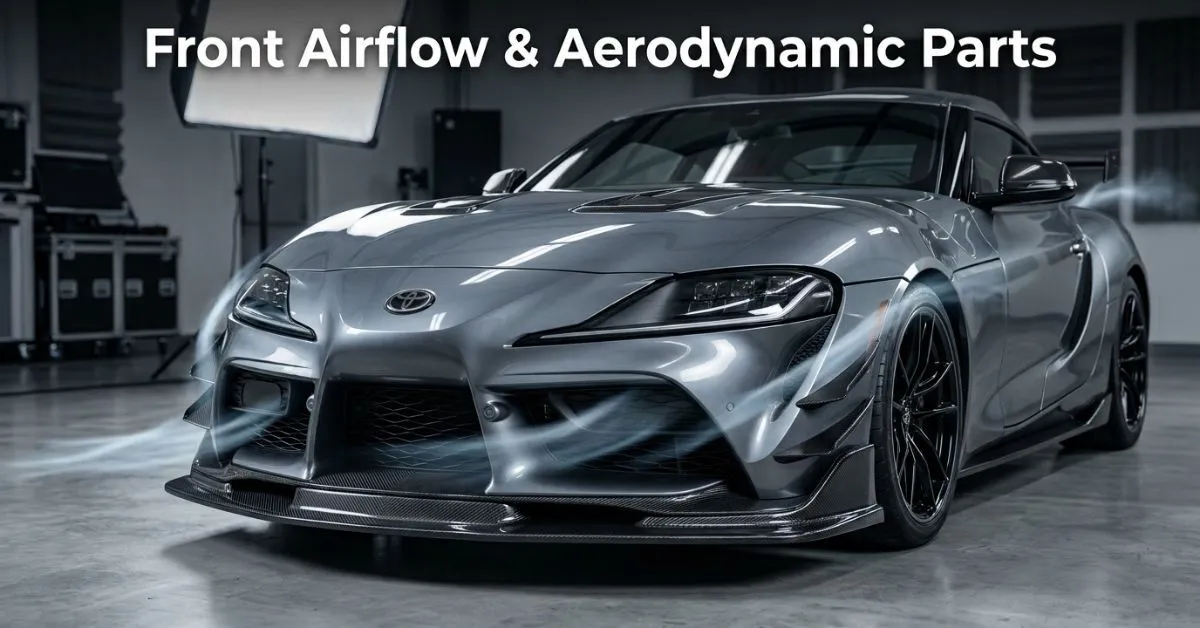
Modern vehicles use many shapes and panels to control how air moves around the front. Some improve airflow for cooling, while others help manage turbulence underneath or around the vehicle.
- Air Intake Grille
Meaning: An opening that allows outside air to enter the front section of the vehicle. - Active Grille Shutter
Meaning: A movable grille system that can open or close to manage airflow and cooling needs. - Lower Air Intake
Meaning: A lower front opening that directs outside air toward cooling or aerodynamic areas. - Air Intake Duct
Meaning: A passage that guides air from an opening toward a specific component. - Brake Cooling Duct
Meaning: A passage designed to direct outside air toward the brakes for additional cooling. - Front Splitter
Meaning: A low front aerodynamic panel that can influence airflow beneath the vehicle. - Air Dam
Meaning: A lower front panel designed to reduce unwanted airflow under the vehicle. - Undertray
Meaning: A panel beneath the front section that can protect components and help manage airflow. - Air Guide
Meaning: A shaped panel or duct that directs air toward a desired location. - Grille Shutter Motor
Meaning: An actuator that moves an electronically controlled active grille shutter.
🏆 Best Choice: Active Grille Shutter is a standout modern term because it shows how newer vehicles can actively control airflow instead of relying on a fixed grille.
🚗 Front Windshield and Wiper Parts
The windshield area is also part of the front section people often mean when identifying car components. These parts help maintain visibility while protecting the cabin from wind, rain, and debris.
- Windshield
Meaning: The large front glass panel that protects occupants while providing forward visibility. - Windshield Wiper Arm
Meaning: The movable arm that carries the wiper blade across the windshield. - Wiper Blade
Meaning: The rubber-edged component that sweeps rain and moisture from the glass. - Wiper Linkage
Meaning: A mechanical connection that transfers movement from the wiper motor to the wiper arms. - Wiper Motor
Meaning: An electric motor that powers the windshield wiper mechanism. - Wiper Pivot
Meaning: The rotating point that allows a wiper arm to move across the windshield. - Washer Nozzle
Meaning: A small outlet that sprays windshield-cleaning fluid onto the glass. - Washer Reservoir
Meaning: A tank that stores windshield washer fluid. - Cowl Grille
Meaning: A vented panel near the bottom of the windshield that helps manage airflow and water. - Windshield Molding
Meaning: Trim surrounding the windshield that helps finish and protect the glass installation.
🏆 Best Choice: Wiper Blade is the most practical term to know because it is the part drivers regularly inspect and replace as visibility needs change.
🔩 Front Engine Bay Parts
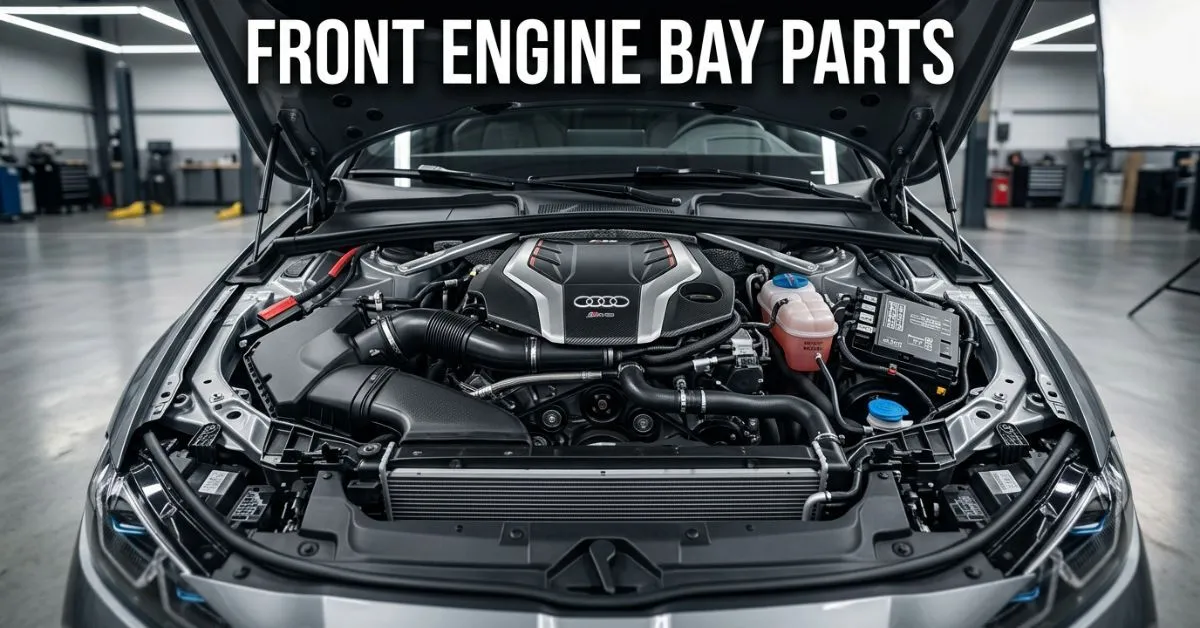
When the hood opens, you can see another group of components near the front of the vehicle. Their exact position depends on engine design, drivetrain layout, and vehicle packaging.
- Engine Mount
Meaning: A support that secures the engine to the vehicle while helping control vibration. - Engine Cover
Meaning: A decorative or protective cover placed over portions of the engine. - Serpentine Belt
Meaning: A belt that drives accessories such as the alternator and other engine-mounted components. - Belt Tensioner
Meaning: A mechanism that maintains proper tension on the serpentine belt. - Idler Pulley
Meaning: A pulley that guides the belt and helps maintain its correct routing. - Alternator
Meaning: An engine-driven electrical component that generates electricity and helps recharge the battery. - A/C Condenser
Meaning: A heat exchanger near the front of the vehicle that releases heat from the air-conditioning refrigerant. - A/C Receiver-Drier
Meaning: A component in certain air-conditioning systems that removes moisture and stores refrigerant. - Engine Cooling Fan
Meaning: A powered fan that helps move air through the radiator and cooling area. - Battery Tray
Meaning: A mounting platform that holds the vehicle battery securely in place.
🏆 Best Choice: A/C Condenser deserves special attention because its front-mounted position makes it an important component when discussing the vehicle’s cooling and climate-control hardware.
🧰 Front End Parts You Can See From Outside
Sometimes you do not need to open the hood or crawl under the car. A quick look from the front can reveal several important parts immediately.
- Grille Emblem Area
Meaning: The central grille area where many vehicles place their identifying emblem or badge. - Fog Light Bezel
Meaning: The trim surrounding a fog-light opening or lamp. - Tow Hook Cover
Meaning: A removable panel that hides a tow-hook mounting point on some vehicles. - Headlight Trim
Meaning: Decorative or finishing material surrounding part of a headlight assembly. - Front License Plate Bracket
Meaning: A mounting piece used to hold a front license plate where required. - Bumper Grille
Meaning: A grille opening built into the bumper area rather than the main upper grille. - Fender Liner
Meaning: A protective inner panel inside the wheel well that blocks dirt and water. - Wheel Arch
Meaning: The curved body opening surrounding the upper portion of a wheel. - Hood Ornament Area
Meaning: The front hood location where some vehicles may have a decorative emblem or ornament. - Front Tow Hook
Meaning: A strong attachment point used for towing or recovery when the vehicle is designed with one.
🏆 Best Choice: Wheel Arch is especially useful when describing body damage because it clearly identifies the curved section surrounding the front tire.
🔍 Front End Parts By Location
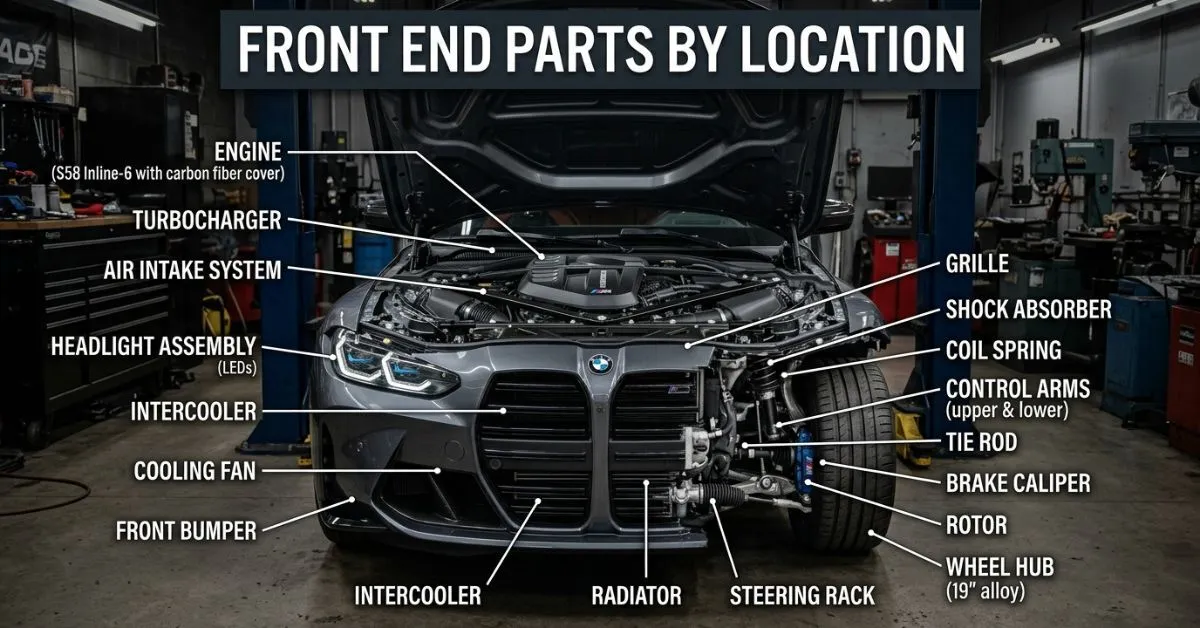
If you are standing in front of a vehicle, location can be the fastest way to identify a part. Think from top to bottom and then outside to inside.
- Upper Front Grille
Meaning: The upper opening or decorative grille area positioned below or between the headlights. - Lower Front Grille
Meaning: The lower opening in the front fascia that commonly supports airflow toward cooling areas. - Hood Edge
Meaning: The frontmost edge of the hood where it meets the surrounding front bodywork. - Fender Edge
Meaning: The outer edge of the front fender surrounding the wheel opening. - Front Bumper Corner
Meaning: The left or right outer portion of the front bumper. - Front Bumper Center
Meaning: The central section of the front bumper located between its two corners. - Wheel Well
Meaning: The open space around the wheel that allows the wheel and suspension to move. - Front Undercarriage
Meaning: The collection of components located underneath the front portion of the vehicle. - Engine Bay
Meaning: The compartment where the engine and many supporting components are installed. - Front Frame Rail
Meaning: A major structural rail running along the front portion of certain vehicle frames or body structures.
🏆 Best Choice: Wheel Well is one of the most useful location terms because it immediately narrows down where suspension, tire, brake, and body components are found.
🚨 Front End Parts That Can Cause Common Problems
Knowing the names is helpful, but understanding why a part matters makes the information more useful. A worn suspension or steering component can sometimes affect handling, tire wear, noise, or alignment. A professional inspection is important because similar symptoms can come from different components.
- Worn Ball Joint
Meaning: A damaged ball joint can create unwanted movement between suspension components. - Damaged Tie Rod End
Meaning: Excessive wear in this steering joint can affect steering linkage movement. - Weak Strut Mount
Meaning: A worn mount may contribute to noise or unwanted movement around the top of the strut. - Failing Wheel Bearing
Meaning: A worn bearing may produce a humming, growling, or rough-rotation sound. - Cracked Control Arm Bushing
Meaning: A damaged bushing can allow more movement between the control arm and its mounting point. - Bent Steering Knuckle
Meaning: A damaged knuckle can affect wheel positioning and related suspension geometry. - Broken Sway Bar Link
Meaning: A failed link can create noise and reduce the stabilizer bar’s normal connection. - Leaking Shock Absorber
Meaning: Fluid leakage can indicate damage to a shock absorber or strut assembly. - Damaged Wheel Hub
Meaning: A damaged hub can create problems with wheel mounting or rotation. - Broken Splash Shield
Meaning: A damaged shield can leave front-end components more exposed to water, dirt, and road debris.
🏆 Best Choice: Ball Joint is a useful term to remember when discussing front suspension inspections because it is a key pivot point in many suspension designs.
🚗 Modern Front End Parts & 2026 Trends

Today’s vehicles can have front-end components that were uncommon or nonexistent on older cars. Electric vehicles, advanced driver-assistance systems, LED lighting, and active aerodynamic systems have changed what can sit behind the front fascia.
- Front Radar Sensor
Meaning: A sensor used by some driver-assistance systems to detect objects and estimate their distance and movement. - Front Camera
Meaning: A camera that can provide visual information for certain driver-assistance and safety features. - Parking Sensor
Meaning: A sensor that helps detect nearby objects during parking or low-speed maneuvers. - Front Sensor Grille
Meaning: A specially designed grille area that allows certain sensors to operate correctly. - LED Headlight Module
Meaning: An integrated lighting unit using light-emitting diodes for illumination. - Adaptive Headlight Unit
Meaning: A lighting assembly capable of changing its light pattern under supported driving conditions. - Active Air Flap
Meaning: A movable aerodynamic panel that opens or closes to control airflow. - Front Camera Washer
Meaning: A cleaning system designed to help keep a forward-facing camera’s viewing area clear on equipped vehicles. - Heat Pump Condenser
Meaning: A component involved in thermal management on certain modern electrified vehicles. - EV Front Cooling Module
Meaning: A collection of cooling components used to manage temperatures in certain electric vehicles.
🏆 Best Choice: Front Radar Sensor is a useful modern term because sensor hardware is increasingly integrated into the front design of newer vehicles.
🎯 How To Choose The Right Front End Part Name
When you are trying to identify a part, do not guess from its appearance alone. Start with location, then determine what the part connects to, and finally check the vehicle’s exact year, make, model, engine, and drivetrain.
- Location First
Meaning: Start by identifying whether the component is above, below, behind, inside, or beside the front wheel. - Function Check
Meaning: Ask whether the part controls steering, suspension, braking, cooling, lighting, structure, or airflow. - Connection Check
Meaning: Look at which other components the unknown part physically connects to. - Driver or Passenger Side
Meaning: Identify whether the component is on the left or right side of the vehicle. - Front or Rear
Meaning: Confirm that the component belongs to the front section before ordering a replacement. - Vehicle Year
Meaning: The model year can determine which version of a component fits the vehicle. - Vehicle Make
Meaning: The manufacturer name helps narrow down the correct component design. - Vehicle Model
Meaning: The exact model identifies the vehicle platform and available component configurations. - Engine Type
Meaning: Engine size or configuration can affect which parts are installed. - Part Number
Meaning: A verified part number provides a much more precise identification than a general component name.
🏆 Best Choice: Part Number is the strongest identification tool when ordering a replacement because a specific number can distinguish between visually similar components.
FAQs:
What are the front end parts?
Front end parts are the components located at the front of a vehicle, including the bumper, grille, headlights, hood, fenders, radiator, suspension components, steering parts, and front windshield and wiper components.
What are the names of suspension parts?
Common suspension parts include shock absorbers, struts, coil springs, control arms, ball joints, sway bar links, tie rods, bushings, steering knuckles, and wheel bearings. The exact components can vary by vehicle.
What is the front end of a car?
The front end of a car refers to the area and components at the front of the vehicle. It generally includes the bumper, grille, headlights, hood, fenders, radiator, steering system, suspension, and other supporting components.
What is front end assembly?
A front end assembly is a group of components installed at the front of a vehicle, often including suspension, steering, wheel hubs, brakes, and related structural parts. The exact meaning can vary depending on the vehicle and repair context.
What are the main front suspension parts?
Common parts include control arms, ball joints, struts or shocks, springs, sway bars, sway bar links, steering knuckles, bushings, and related mounting hardware.
What connects the steering system to the front wheels?
Depending on the steering design, components such as inner and outer tie rods transfer steering movement toward the front wheel assemblies.
What is the part that holds the front wheel?
The wheel hub is the central component that the wheel mounts to. Many vehicles use a hub assembly containing an integrated wheel bearing.
What is the metal part behind the bumper called?
It is commonly called the bumper reinforcement or bumper reinforcement beam. The exact design depends on the vehicle.
What is the plastic part under the front bumper called?
It may be called an air dam, lower valance, splash shield, or undertray, depending on its exact location and purpose.
Are all front end parts the same on every car?
No. Front-end layouts vary by vehicle, model year, drivetrain, suspension design, engine configuration, and manufacturer.
Conclusion:
Understanding front end parts names makes car terminology far less confusing. What looks like one large section at the front is actually a collection of body, steering, suspension, braking, cooling, lighting, structural, and aerodynamic components.
We covered familiar parts such as the hood, bumper, grille, fender, and headlights, along with less visible components like control arms, ball joints, tie rods, steering knuckles, wheel hubs, bearings, radiator supports, and subframes.
We also looked at newer components such as radar sensors, cameras, LED modules, and active airflow systems.
When identifying a part, start with its location. Then look at what it connects to and what job it performs. Finally, confirm the exact vehicle details before buying a replacement.
Once these names become familiar, even a complicated front-end diagram starts to look much simpler. Know the part, understand its job, and the whole front end begins to make sense.

I’m James Anderson, a names expert and author at Unlocknames.com, passionate about exploring name meanings, origins, history, and unique names ideas.