People searching for inhalants street names are often trying to understand a word they heard, read, or saw online.
A slang term can be confusing because the same word may refer to different substances in different places or time periods.
Official U.S. sources such as the DEA and NIDA document terms including Gluey, Huff, Rush, Whippets, Poppers, Snappers, and Laughing Gas in connection with inhalants or specific inhaled substances.
This guide explains documented inhalant slang in plain American English. It also separates broad inhalant terms from words linked to specific substances, such as nitrous oxide or nitrites. That difference matters.
A slang word does not always identify one exact chemical. If you are a parent, teacher, writer, researcher, or simply someone trying to understand a conversation, keep reading for a clear reference without the confusing jargon.
⚡ Quick Answer
Inhalants street names: are informal slang terms used for inhalants or particular substances that may be inhaled. Documented examples include Huff, Gluey, Whippets, Rush, Poppers, Snappers, Highball, Hippie Crack, Laughing Gas, and Moon Gas. Slang changes over time, and one term may have more than one meaning.
What Do Inhalants Street Names Really Mean?
“Inhalants street names” simply means informal words or slang used to describe inhalants, inhalant-related substances, or their misuse. Inhalants are a broad category, not one single drug. The DEA describes them as volatile substances found in products that can produce mind-altering effects when their vapors are inhaled.
Some slang terms point to a broad category, while others are linked with particular substances. For example, Whippets and Laughing Gas are associated with nitrous oxide, while Poppers and Snappers are associated with nitrites in many reference sources.
In my experience reviewing naming and language patterns, drug slang is one area where context matters more than the word alone. A single term can shift meaning across regions and generations, so a slang word should never be treated as proof of a specific substance by itself.
🗣️ Common Inhalants Street Names
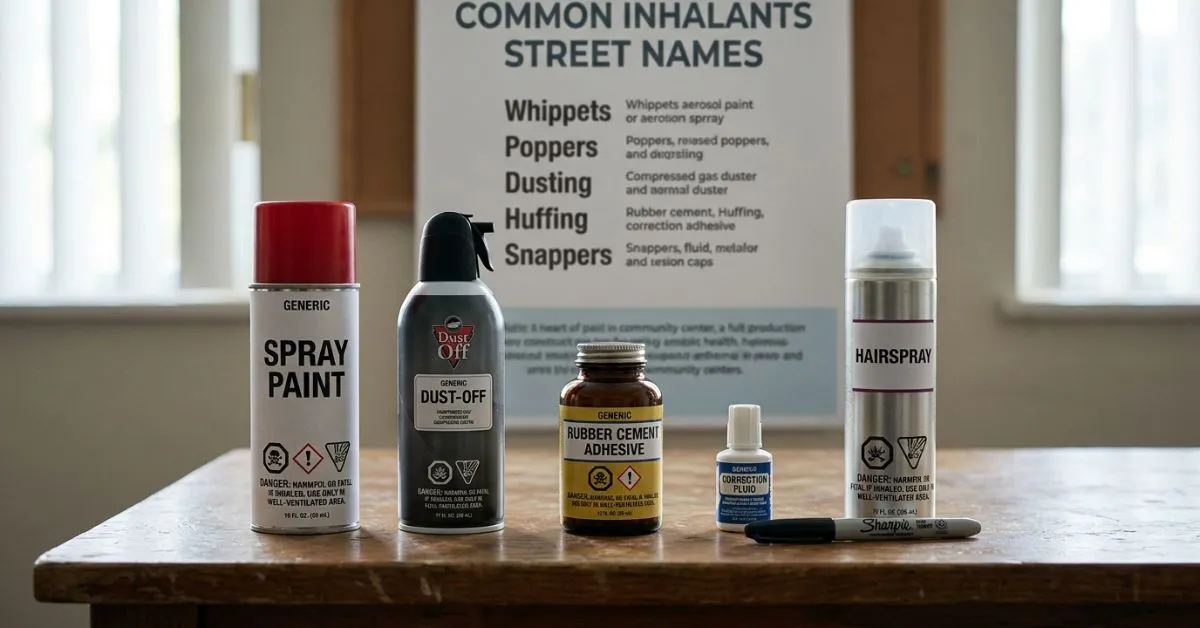
The most useful place to start is with terms that have been documented in U.S. drug-reference materials. These words may appear in older reports, educational material, law-enforcement references, or everyday conversations about substance use.
- Huff
Meaning: A documented slang term connected with inhalants and the act of inhaling their vapors. - Gluey
Meaning: A term associated with someone who inhales glue or with glue-related inhalant use. - Rush
Meaning: A documented term that can refer to inhalants but may also have other drug-related meanings. - Whippets
Meaning: A slang term commonly associated with nitrous oxide in inhalant references. - Highball
Meaning: An older documented slang term associated with inhalants. - Hippie Crack
Meaning: A slang expression documented for inhalants, especially in references discussing nitrous oxide. - Moon Gas
Meaning: A documented historical slang term associated with inhalants. - Medusa
Meaning: An older slang term listed in reference materials as an inhalant-related name. - Satan’s Secret
Meaning: A historical slang expression documented as a name for inhalants. - Poor Man’s Pot
Meaning: An older slang expression documented in drug-reference lists for inhalants.
🏆 Best Choice: Huff is the most useful term to recognize in general awareness because the DEA itself lists it among inhalant street names.
🎈 Nitrous Oxide Related Street Names
Not every inhalant slang term describes the same type of substance. Some names are specifically connected with nitrous oxide, which NIDA lists among inhalants and associates with terms such as “whippets” and “laughing gas.”
- Laughing Gas
Meaning: A common informal name for nitrous oxide that appears in official drug-reference material. - Whippets
Meaning: A slang term associated with nitrous oxide in inhalant references. - Shoot the Breeze
Meaning: A documented slang expression associated with nitrous oxide. - Buzz Bomb
Meaning: An older documented term associated with nitrous oxide. - Moon Gas
Meaning: A historical inhalant slang term that appears in reference lists and may be associated with inhaled gases. - Hippie Crack
Meaning: A historical slang expression associated with inhalants and particularly nitrous oxide references. - Snappers
Meaning: A documented term that is more often connected with nitrites but can appear in broader inhalant slang lists. - Poppers
Meaning: A term commonly associated with nitrites, which NIDA includes within its inhalant information. - Rush Snappers
Meaning: A historical term associated with nitrite products in older slang references. - Aroma of Men
Meaning: An older documented slang expression associated with isobutyl nitrite.
🏆 Best Choice: Laughing Gas is the clearest term in this group because its meaning is easy to understand and is directly documented as a name for nitrous oxide.
🧪 Older Inhalant Slang Terms

Drug slang is not fixed. Some terms found in older references may be uncommon today, yet they can still appear in books, archived material, or conversations about past drug culture. That is why historical context matters when interpreting these words.
- Air Blast
Meaning: A documented historical term used for inhalants. - Bolt
Meaning: An older slang term that has been associated with inhalants as well as other substances. - Bullet Bolt
Meaning: A historical term listed in reference material for inhalants. - Discorama
Meaning: An older slang word documented as an inhalant-related term. - Heart-On
Meaning: A historical slang expression listed in connection with inhalants. - Hardware
Meaning: A documented slang term that can refer to inhalants or certain nitrite products. - Quicksilver
Meaning: An older term documented for inhalants and certain nitrites. - Texas Shoe Shine
Meaning: A historical slang expression documented for inhalants. - Thrust
Meaning: An older term listed in reference material for inhalants and nitrites. - Whiteout
Meaning: A documented slang term associated with inhalants and, in some sources, nitrites.
🏆 Best Choice: Air Blast stands out here because it directly appears as a historical term for inhalants rather than sounding like a nickname for a particular person or product.
👀 Inhalant Terms Parents May Encounter
Parents do not need to memorize every slang word. A better goal is to recognize that informal language can hide the real meaning of a conversation. Official sources also warn that inhalants can be extremely dangerous, with serious effects possible even during a single episode of misuse.
- Huff
Meaning: A common documented word connected with inhalant use. - Whippets
Meaning: A term associated with nitrous oxide in official drug references. - Poppers
Meaning: A slang term associated with nitrite products in NIDA material. - Snappers
Meaning: A related slang term often associated with nitrites. - Laughing Gas
Meaning: An informal name for nitrous oxide that can appear in drug-related conversations. - Highball
Meaning: A documented older term associated with inhalants. - Hippie Crack
Meaning: A slang expression found in inhalant references, particularly around nitrous oxide. - Gluey
Meaning: A term associated with glue inhalation and inhalant use. - Moon Gas
Meaning: A historical term found in inhalant slang references. - Whiteout
Meaning: A historical slang term documented in connection with inhalants.
🏆 Best Choice: Huff is the key word for parents to recognize because it appears directly in current DEA inhalant information.
🔎 Why Inhalant Slang Can Be Confusing
A slang word is not a chemical test. The same term can have several meanings, and meanings can change between communities, locations, and time periods. SAMHSA notes that its Drug Abuse Warning Network tracks drug-specific names and slang because understanding those terms helps identify substance-related language and avoid misunderstandings.
- Rush
Meaning: A term that has been documented for inhalants but also appears with other drugs. - Poppers
Meaning: A word that can point to nitrite products rather than every type of inhalant. - Hardware
Meaning: A historical term that has been linked with inhalants and isobutyl nitrite. - Bolt
Meaning: A term with more than one documented drug-related meaning, showing why context matters. - Climax
Meaning: An older slang term recorded with multiple drug-related meanings, including inhalants. - Honey Oil
Meaning: A historical term that has been associated with more than one substance, including inhalants. - Sniff
Meaning: A broad informal word that can describe inhaling but does not identify one specific substance. - Snort
Meaning: A general drug-related verb that can have several meanings and should not automatically be read as an inhalant reference. - Spray
Meaning: A historical inhalant-related term that is too broad to identify a particular chemical by itself. - Oz
Meaning: An older slang term documented in connection with inhalants but also capable of appearing in other contexts.
🏆 Best Choice: Rush is the clearest lesson in why context matters: official and historical sources associate it with inhalants, but it can also refer to other substances.
🧩 Inhalant Slang Vs. Specific Substances
One important detail can make this topic much easier to understand: not every slang term identifies the same substance. The DEA currently lists “Gluey,” “Huff,” “Rush,” and “Whippets” as inhalant street names, while NIDA groups terms such as “laughing gas,” “poppers,” “snappers,” and “whippets” with different inhalant substances.
- Solvent Slang
Meaning: This broad label can refer to slang connected with volatile chemical products rather than one specific drug. - Gas Slang
Meaning: This describes informal language used for inhaled gases, but it does not identify the exact chemical. - Nitrite Slang
Meaning: This refers to terms associated with volatile nitrites, including names such as poppers and snappers. - Nitrous Slang
Meaning: This points toward informal terms connected with nitrous oxide, including whippets and laughing gas. - Chemical Slang
Meaning: This is a general way to describe informal references to volatile household or commercial chemicals. - Vapor Slang
Meaning: This phrase can describe language about inhaled chemical vapors without naming one particular substance. - Volatile Slang
Meaning: This wording reflects the volatile nature of many substances classified as inhalants. - Solvent Terms
Meaning: This phrase is useful when discussing slang connected with solvent-based inhalants. - Gas Terms
Meaning: This general label can describe slang connected with gaseous inhalants. - Inhalant Terms
Meaning: This is the broadest description for informal names connected with substances classified as inhalants.
🏆 Best Choice: Nitrous Slang is the clearest category when a conversation specifically points toward nitrous oxide, because official NIDA material connects nitrous oxide with “laughing gas” and “whippets.”
📚 Historical Inhalant Names To Recognize
Some inhalant terminology comes from older reference material. These words may not be common in everyday speech today, so treating every historical term as modern slang would be misleading.
- Bang
Meaning: An older documented street term associated with inhalants. - Oz
Meaning: A historical term that appears in older NIDA material concerning inhalants. - Locker Room
Meaning: A documented older expression associated with nitrite products. - Ocean
Meaning: A historical street term recorded in older NIDA material for a particular aerosol-related mixture. - Air Blast
Meaning: A historical inhalant-related term found in older slang references. - Discorama
Meaning: An older term appearing in historical inhalant slang references. - Quicksilver
Meaning: A historical expression that has been associated with inhalant-related slang. - Texas Shoe Shine
Meaning: An older slang expression connected with inhalants in historical references. - Medusa
Meaning: A historical inhalant-related slang term found in older reference lists. - Satan’s Secret
Meaning: An older expression documented in historical inhalant slang material.
🏆 Best Choice: Locker Room is particularly useful for historical research because it appears in older NIDA material as a documented inhalant-related street term.
🌎 Regional and Context Clues Matter
Street language does not work like a dictionary with one permanent definition for every word. A term can be old, regional, connected to several substances, or used differently from one group to another. SAMHSA’s Drug Reference Vocabulary exists partly because substance names and categories need consistent classification in public-health data.
- Local Slang
Meaning: This describes terminology that may be understood within one community but not another. - Youth Slang
Meaning: This refers to informal language that can change quickly among younger groups. - Online Slang
Meaning: This describes terms that spread through online conversations and may change meaning over time. - Historical Slang
Meaning: This label helps distinguish older terminology from words commonly used today. - Regional Terms
Meaning: This phrase highlights words whose meaning may depend on geographic context. - Community Terms
Meaning: These are expressions that may develop within a particular social group. - Drug Vocabulary
Meaning: This broad term covers informal and formal language used when discussing substances. - Code Words
Meaning: A code word is an indirect expression whose meaning depends heavily on surrounding conversation. - Hidden Language
Meaning: This phrase describes slang that may make a substance reference less obvious to outsiders. - Context Clues
Meaning: These are the surrounding words and circumstances that help explain what a slang term means.
🏆 Best Choice: Context Clues is the most useful concept here because a slang word alone may not establish which substance someone means.
🧠 What Inhalant Slang Can Tell You

Knowing a slang word can help someone understand a conversation, but it should not be treated as proof that a person is using drugs. A single word can have ordinary meanings too. Inhalants themselves cover a wide range of chemicals and products, which makes context especially important.
- Awareness
Meaning: This represents the goal of recognizing unfamiliar substance-related language without jumping to conclusions. - Context
Meaning: This reminds readers to consider the full conversation rather than one isolated word. - Clarity
Meaning: This name represents the need to understand confusing slang in plain language. - Recognition
Meaning: This focuses on noticing unfamiliar terminology when it appears. - Education
Meaning: This reflects learning what a term means instead of relying on rumors. - Prevention
Meaning: This represents using accurate information to support safer choices. - Communication
Meaning: This highlights the value of calm, honest conversations about unfamiliar drug language. - Understanding
Meaning: This focuses on learning the meaning behind a word before reacting to it. - Research
Meaning: This represents checking reliable sources when slang has several possible meanings. - Safety
Meaning: This emphasizes the public-health reason for learning about potentially dangerous substances.
🏆 Best Choice: Awareness works especially well because the purpose of learning drug slang is understanding, not labeling people.
🚨 Why Inhalants Deserve Serious Attention
The names may sound casual, but the substances behind them can carry serious health risks. The DEA warns that inhalant misuse can cause loss of consciousness and, in some circumstances, death; it also notes that sudden death can occur even during a single episode.
- Risk Awareness
Meaning: This phrase captures the need to understand that familiar-sounding slang can refer to dangerous substances. - Health Alert
Meaning: This represents a reminder that inhalant exposure can affect the brain, heart, lungs, and other organs. - Emergency Signal
Meaning: This describes information that helps people recognize when a situation may require urgent medical attention. - Medical Concern
Meaning: This highlights that serious inhalant exposure is a health issue, not simply a slang-language question. - Early Warning
Meaning: This represents noticing concerning signs before a situation becomes more serious. - Public Health
Meaning: This connects inhalant awareness with broader community education and prevention. - Family Awareness
Meaning: This reflects the value of parents and caregivers understanding unfamiliar substance language. - Youth Safety
Meaning: This focuses on prevention and education among younger people. - Risk Check
Meaning: This represents pausing to assess a concerning situation instead of ignoring it. - Emergency Care
Meaning: This emphasizes getting professional medical help when someone experiences a serious reaction.
🏆 Best Choice: Early Warning fits this section because recognizing a concerning situation early can help someone seek appropriate support.
👨👩👧 What Parents Should Do With Slang Terms

Parents do not need to become experts in every new slang word. The better approach is to stay calm, ask questions, and look for context. Official sources describe signs that can accompany inhalant exposure, including chemical odors, red or runny eyes or nose, slurred speech, dizziness, and poor coordination.
- Ask First
Meaning: This encourages a calm question before making an accusation. - Listen Closely
Meaning: This represents paying attention to the full conversation instead of one unfamiliar word. - Check Context
Meaning: This reminds parents that slang can have several meanings. - Stay Calm
Meaning: This encourages a measured response during a difficult conversation. - Open Talk
Meaning: This represents creating space for honest discussion about substance risks. - Trustworthy Sources
Meaning: This highlights the value of checking official health information instead of social-media rumors. - Family Support
Meaning: This represents offering help rather than relying only on punishment. - Clear Questions
Meaning: This encourages simple, direct questions that are easy for a young person to answer. - Health Check
Meaning: This emphasizes taking physical symptoms seriously. - Professional Help
Meaning: This points toward qualified medical or behavioral-health support when concerns become serious.
🏆 Best Choice: Open Talk is especially useful for families because a calm conversation can create room for facts, questions, and support.
🛡️ How To Use Inhalant Street Names Responsibly
A useful article about drug slang should inform readers without turning slang into a how-to guide. The safest use of these terms is for education, prevention, writing, research, or understanding something you have already encountered.
- Learn
Meaning: Use documented information to understand unfamiliar terminology. - Verify
Meaning: Check important drug-related claims against reliable health or government sources. - Question
Meaning: Ask what a term means instead of assuming its definition. - Compare
Meaning: Look at multiple trustworthy references when a word has conflicting meanings. - Protect
Meaning: Use knowledge to support the safety of yourself and others. - Discuss
Meaning: Talk openly with a trusted person when substance-related language causes concern. - Report
Meaning: Share serious safety concerns with an appropriate adult, professional, or emergency service. - Avoid
Meaning: Do not treat slang terminology as an invitation to experiment with a substance. - Educate
Meaning: Share accurate facts rather than repeating rumors or exaggerated claims. - Support
Meaning: Remember that someone struggling with substance use may need help rather than shame.
🏆 Best Choice: Verify is the standout because slang changes quickly, while reliable sources provide a stronger foundation for understanding it.
📈 Inhalant Slang Trends & Modern Language

There is no single official list that can tell us every slang term currently used across the United States. DEA’s current inhalant page lists Gluey, Huff, Rush, and Whippets, while NIDA materials identify additional terms tied to specific inhalant categories.
- Current Reference
Meaning: This represents terminology appearing in contemporary official reference material. - Modern Usage
Meaning: This describes language that may appear in present-day conversations without claiming universal popularity. - Changing Slang
Meaning: This reflects how informal drug vocabulary can evolve over time. - Digital Language
Meaning: This represents terminology that may spread through online communication. - New Terms
Meaning: This refers to emerging expressions that require reliable documentation before being treated as established slang. - Old Terms
Meaning: This helps readers identify words that mainly belong to historical sources. - Updated Vocabulary
Meaning: This represents the need to refresh drug-language references as terminology changes. - Source Check
Meaning: This means confirming whether a term is actually documented rather than simply repeated online. - Language Shift
Meaning: This describes changes in the way communities refer to substances. - Slang Evolution
Meaning: This captures the ongoing process through which informal words gain, lose, or change meaning.
🏆 Best Choice: Changing Slang is the strongest fit because it explains why an old list should not automatically be treated as a current national slang dictionary.
🎯 How To Understand An Inhalant Street Name
When you encounter an unfamiliar term, there is a simple way to approach it. Start with the word, check its source, identify whether it is current or historical, and then look at the surrounding context.
- Identify
Meaning: First determine the exact word or phrase that you encountered. - Source
Meaning: Find out where the term was documented or published. - Date
Meaning: Check whether the source is recent or historical. - Category
Meaning: Determine whether the term refers broadly to inhalants or to a particular substance. - Context
Meaning: Read the surrounding conversation before deciding what the word means. - Location
Meaning: Consider whether the term may be regional rather than nationally common. - Purpose
Meaning: Ask whether the word is being used for education, conversation, fiction, or another purpose. - Confirmation
Meaning: Compare the term with another reliable reference when possible. - Caution
Meaning: Avoid assuming that knowing a slang term tells you exactly what substance was involved. - Help
Meaning: Seek qualified assistance when the language is connected with a possible health emergency.
🏆 Best Choice: Confirmation is the key step because one source or one conversation may not provide enough context.
FAQs:
What are the most common inhalants street names?
The DEA’s current inhalant page lists Gluey, Huff, Rush, and Whippets as street names. NIDA also documents terms including laughing gas, poppers, snappers, and whippets in its inhalant information.
What does “huff” mean?
“Huff” is a documented inhalant-related slang term. The DEA uses the word in its inhalant information and describes huffing as one form of inhalant misuse.
What are whippets?
“Whippets” is a slang term associated with nitrous oxide in official drug-reference material. NIDA identifies nitrous oxide as an inhalant and connects it with the term “whippets.”
Is “poppers” an inhalant street name?
“Poppers” is a term associated with volatile nitrites. NIDA includes nitrites such as amyl, butyl, and related compounds within its inhalant information.
Is every slang word proof that someone is using inhalants?
No. A slang term alone does not prove substance use. Some words have ordinary meanings, while others can refer to more than one substance or activity.
Why are there so many inhalant slang terms?
Inhalants cover many different chemical substances and products. Informal language also changes by time, place, and social group, which creates overlapping terminology.
Can inhalants be dangerous after one use?
Yes. The DEA warns that sudden sniffing death can occur during a single episode of inhalant misuse, including in otherwise healthy young people.
What should I do if someone becomes unconscious after inhalant exposure?
Treat unconsciousness or serious breathing problems as a medical emergency and call 911 in the United States. Do not rely on slang knowledge to judge the seriousness of the situation. The DEA specifically warns that inhalant exposure can result in loss of consciousness and death.
Conclusion:
Understanding inhalants street names is less about memorizing a giant slang dictionary and more about knowing how to interpret unfamiliar language carefully.
Terms such as Huff, Gluey, Rush, Whippets, Laughing Gas, Poppers, and Snappers appear in official or historical U.S. drug references, but they do not all describe the same substance.
We also looked at historical terms, context clues, regional language, family conversations, modern slang changes, and ways to verify a word before assuming what it means.
That last step matters most. Slang can be vague, outdated, or used differently from one group to another.
If you found a particular word somewhere, use the surrounding conversation and a reliable source to understand it.
And if the question involves possible inhalant exposure, focus on the person’s health rather than the slang itself. Accurate information can turn a confusing word into a useful warning sign.
Final 20-Word Meta Description
Learn inhalants street names, common slang, historical terms, and key context so confusing drug language is easier to understand safely.

I am Noah Parker, a names expert and author at Unlocknames.com, passionate about exploring the meanings, origins, and significance of names.